|
|
|
|
|
 |
| |
| KUALA LUMPUR |
|
The Capital City
Kuala Lumpur, is the capital city of the Federation of Malaysia. The city began as a mining town in the middle of the 19th century with the discovery of tin at the confluence of the Klang and Gombak rivers. This marked the foundation of Kuala Lumpur.
Today, it is a bustling metropolis and represents the heartbeat of the nation serves as the principal center of commerce, politics, entertainment and international activities.
Better known as KL to the locals is by far the largest city in Malaysia. Situated midway along the west coast of Peninsular Malaysia, it has a land area of approximately 243.6 sq. km. People from all over the country and all type of ethnicity are drawn to Kuala Lumpur in search of fortune. Malay, Chinese and Indians comprise the main races among others in this multicultural backdrop. This ethnic diversity has shaped the city over the years and is clearly seen in the various cultural customs and religious beliefs, as well as languages, cuisine and architecture. |
Kuala Lumpur is a mix of history and culture intertwined with mushrooming skyscrapers and office towers. Kuala Lumpur is the best example of a city that has managed to preserve the best of its cultural heritage and combine it with modern conveniences to offer a wholly unique experience to visitors.
|
[Back To Top] |
|
It was a situation where the Federal Capital was sited on the territory of Selangor whereby is a member state of the Federation of Malaysia that leads the ceding of Kuala Lumpur from Selangor to the Federal Government on 1st. February 1974.
Kuala Lumpur is zoned into eleven (11) constituencies (which we similarized it the same as districts) where each one has its own exciting dining and entertainment, thrilling recreation and sensational shopping centers. Whatever you are looking for, the city has something for everyone to enjoy.
|
|
| Bandar Tun Razak |
Batu |
| Bukit Bintang |
Cheras |
| Kepong |
Lembah Pantai |
| Segambut |
Seputeh |
| Setiawangsa |
Titiwangsa |
| Wangsa Maju |
|
[Back To Top] |
Kuala Lumpur, all around surrounded by Selangor, lies approximately 35 km. from the coast.
The tropical climate in Kuala Lumpur makes the weather warm and pleasant all year round with temperatures between 28 to 33 degrees centigrade. Generally, rain occasionally year round.
[Back To Top] |
Kuala Lumpur offers a variety of accommodation that suits all preferences and budgets. Visitors can choose from international-standard hotels and resorts, serviced apartments, to budget and backpacker accommodations. Most accommodations are strategically located in the city center, adjacent to shopping precincts.
|
|
| |
Islands / Beaches |
|
|
|
|
|
Rainforest
(Lakes / Rivers / Wetlands / Caves)
|
|
|
|
|
|
Sports & Recreation |
|
|
|
|
|
Monuments / Buildings |
|
|
|
|
|
|
|
|
|
|
|
|
|
|
|
|
|
Museums / Arts & Culture / Historical |
|
|
|
|
|
|
|
|
|
|
|
|
|
|
|
|
|
|
|
|
|
|
|
|
|
|
|
|
|
Shopping |
|
|
|
|
|
|
|
|
|
Petronas Twin Towers |
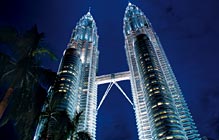
Towering 451.9 metres and 88 floors over the city, this gleaming structure of steel and glass lays claim to being the world's tallest freestanding twin towers.
A world-renowned icon of Malaysia, they are truly an awesome sight in the day and majestic by night; where the twin towers prominently sculpts the KL city skyline.
A lesser-known fact about the twin towers is that the floor plate of the towers were designed based on geometric patterns common in Islamic architectural heritage. These patterns describe important Islamic principles of 'unity, harmony, stability and rationality'.
Connecting the twin towers at levels 41 and 42 is the double-decked Sky Bridge. The Sky Bridge symbolises the gateway to the future. Visitors can experience the exhilarating 'top of the world' feeling on level 41 of the Sky Bridge. From the Sky Bridge, visitors can see the KLCC Park - an aesthetically pleasing landscaped area, featuring indigenous trees and palms; sculptures, murals, and fountain displays.
Admission to the Sky Bridge is free.
Visitors need to get their tickets from the ticket counter between 8.30am - 5.00pm, every
Tuesdays to Sundays.
The Sky Bridge is closed on Mondays.
|
| [Back To Top] |
| |
Petronas Philharmonic Hall |
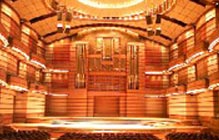
Strategically located at the Petronas Twin Towers, the Petronas Philharmonic Hall is Malaysia's first dedicated classical music hall. The beautiful hall is equipped with the latest facilities, plush seating and delights each visitor with superb acoustics.
It is home to the Malaysian Philharmonic Orchestra comprising an impressive cast of local and international musicians.The hall regularly features regular concerts, recitals, chamber concerts and traditional cultural performances by the Petronas Cultural Troupe.
Since opening its doors in 1998, visitors have been treated to a host of world-renowned classical artists and orchestras, as well as international jazz musicians, traditional Malaysian music and dance productions.
As the first purpose-built concert hall in Malaysia, the Petronas Philharmonic Hall aims to be the focal point for enthusiastic classical music audiences, as well as those of other complementary musical styles such as jazz and world music.
The good news for you is this, even if you are planning to spend just a few days in Kuala Lumpur, you stand a very good chance of catching an amazing performance at the Philharmonic Hall.
|
| [Back To Top] |
| |
KL Tower |
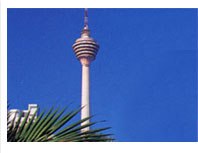
This KL communications tower located atop Bukit Nanas is the world's fourth tallest.
Standing at 421 metres, the KL Tower stands steadfast beside its well-known cousin, the Petronas Twin Towers.
To experience the exhilarating view from the KL Tower, visitors can go to the 335-metre high observation deck
From here, visitors can observe Kuala Lumpur city below and the world's only forest reserve in the middle of a city.
The Bukit Nanas Forest reserve, also known as the 'Green Lung' of KL City, is located just beside the KL Tower. The Bukit Nanas Forest Reserve has flora and fauna indigenous to Malaysia and offers tourists and visitors the opportunity to see colourful butterflies, insects, monkeys, squirrels and exotic birds in their natural habitat.
|
| [Back To Top] |
| |
National Science Centre |
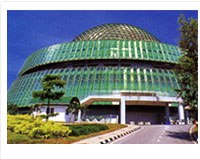
Situated in a pleasant and beautiful environment, visitors can admire the futuristic-looking building, which is shaped like a truncated cone and covered with a huge geodesic dome.
Established in 1996 to promote science and technology in the country, the centre features fascinating themes such as An Environmental Odyssey, Pathways to Discovery, Future World and Thinking Machines.
Amidst such themes, visitors at the National Science Centre can interact with a multitude of exhibits.
These exhibits are engineered to stimulate and encourage visitors to take an active interest in Science and Technology; where science is linked to environment and religion, as well as to explaining the use of scientific knowledge and applications in daily life.
| Opening times : |
| * Monday to Thursday: 9.00am - 5.00pm |
| * Friday: 9.00am - 12.15pm & 2.45pm - 5.00pm |
| * Saturday: 9.00am - 1.30pm |
| * Sundays & Public holidays: closed |
|
| [Back To Top] |
| |
National Planetarium |
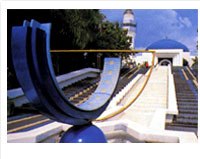
Located magnificently atop a hill in the Lake Gardens, the National Planetarium is an impressive blue-domed structure. Opened in 1994, the National Planetarium represents Malaysia's march towards becoming a progressive society.
The Planetarium's futuristic design features an Observatory equipped with a 35.5cm (14in) telescope which provides visitors a stunning view of the sky; and a space-themed park, where visitors can marvel at replicas of ancient observatories.
Also, visitors from the Planetarium can easily access the National Museum via an overhead pedestrian bridge.
The National Planetarium is open daily from 10.00 am to 4.00 pm, except on Fridays, when it is closed.
|
| [Back To Top] |
| |
National Museum |
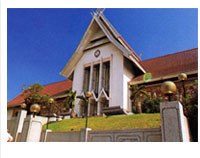
Located on the fringe of the Lake Gardens, the National Museum is the leading museum in the country, serving as a repository for Malaysia's rich cultural heritage and history.
Styled like a traditional Malay palace, the National Museum has a remarkable facade of two large murals which portray scenes of Malaysia's colourful past and rich culture.
Within the walls of the National Museum are well-designed displays and exhibits on local history; culture and traditions; arts and crafts; economic activities; local flora and fauna; weapons and currency.
The National Museum houses various galleries, each with its own theme. The Historical Gallery traces the different periods in the history of Peninsular Malaysia. The Cultural Gallery showcases Malaysian culture from common everyday pastimes to important ceremonial customs.
Included in the exhibits are a Malay wedding scene, a royal circumcision ceremony, and a presentation on the heritage of the Straits-born Chinese. The Metalwork and Musical Instruments Gallery showcases various objects and utensils from kitchenware and ceremonial ornaments to weapons and traditional instruments of Malaysian music.
Decorating the exterior compound of the National Museum are old locomotives, vintage cars and other relics of transport from days gone by. Reconstructed Malay palaces from others parts of the country also grace the expansive grounds. The National Museum holds regular theme-based exhibitions featuring specific aspects of life and culture from all over the world.
Opening hours: Daily from 9.00am - 6.00pm
|
| [Back To Top] |
| |
National Monument |
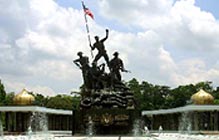
Within the National Monument grounds is one of the world's largest free-standing bronze sculptures. It was sculpted in 1966 by Felix de Weldon, who was also the creator of the famous Iwo Jima monument in Washington DC.
The seven soldiers atop the national monument symbolise the loyalty, sacrifice and co-operation of the people of Malaysia. Built in honour of those who had fought (and those who fell) in World War II and the Emergency of Malaya, this monument sits on a tranquil spot, surrounded by a pool of water fountains and water lilies made of pewter.
Beside the National Monument are the ASEAN Gardens and the Memorial Tun Razak which, houses memorabilia of Malaysia's second Prime Minister, the late Tun Abdul Razak Hussein.
|
| [Back To Top] |
| |
National Mosque |
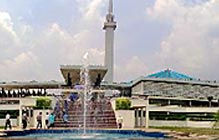
The main dome of the national mosque is designed in the shape of an 18-point star to represent the 13 states of Malaysia and the five central Pillars of Islam, and has the appearance of a partly opened umbrella roof which symbolises the aspirations of an independent nation.
As one of Southeast Asia's largest mosques, its unique modern design embodies a contemporary expression of traditional Islamic art, calligraphy and ornamentation.
Have a quick look at your city map. You'll notice that the National Mosque is right next to the architecturally fabulous old railway station, and just a short walk to the sprawling Lake Gardens and National Monument. If you have the energy, make a walking tour of it by stringing these attractions together.
|
| [Back To Top] |
| |
Islamic Arts Museum |
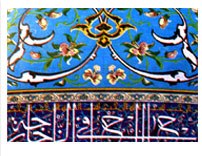
Immerse in the beauty of Islamic arts and the great civilization that inspired it. The Islamic Arts Museum is the first in the region to be exclusively dedicated to Islamic art.
Distinctively Islamic, the mosque has four magnificent domes. Unique in its design, there is a fifth dome that can only be seen from the inside.
Various galleries are dedicated to architecture; Islamic manuscripts; ceramics and glassware; metalwork; arms and armours; textiles and coins. The Islamic arts of the Moghuls of India; the Muslim minorities of China; and the Malay Archipelago are also featured.
The Islamic Arts Museum is open from 10.00am - 6.00pm daily, except on Mondays, when it is closed. It is located on Jalan Perdana overlooking the National Mosque.
|
| [Back To Top] |
| |
Istana Budaya (National Theatre) |
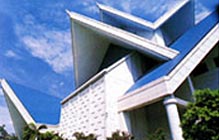
Among the top ten most sophisticated theatres in the world, Istana Budaya (meaning 'Palace of Culture') is proud to be the first theatre in Asia equipped with cutting-edge stage equipment that is on par with the Royal Albert Hall in London.
The main building takes the form of the 'sirih junjung' (a traditional arrangement of betel leaves used in Malay weddings and welcoming ceremonies), and is divided by function, based on a traditional Malay house.
The interior of the Istana Budaya is something you won't want to miss as it is built from Langkawi marble and decorated with tropical wooden doors which feature hand-carved flower and leaf motifs. In short, this place is a work of art in and of itself.
On its annual calendar are international cultural and musical performances as well as concerts and ballet performances. These performances are dependent on the promoter's annual schedule.
|
| [Back To Top] |
| |
'Dataran Merdeka' or Merdeka Square |
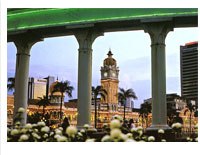
Literally translated as "Independence Square", Dataran Merdeka is an excellent locale to journey into KL's past.
It was here that the Union Jack was lowered on 31st August 1957, signifying the end of British colonial rule. And at that moment, in front of thousands of thrilled Malaysians, Tunku Abdul Rahman led the famous chant: "Merdeka! Merdeka! Merdeka!" (Independence!) indicating Malaysia's independence as a nation.
Today, a 100-metre high flagpole proudly flies the Malaysian flag as a symbol of the historic independence day.
The Padang or field here was the focal point of KL in the old days, serving as a police parade ground and venue for cricket and other sporting activities. The beautifully landscaped square provides impressive views of the city skyline.
Overlooking the square is the Selangor Club. Originally built around 1890, this charming mock-Tudor structure used to be a watering hole for Kuala Lumpur high society.
|
| [Back To Top] |
| |
Tourism Malaysia Centre |
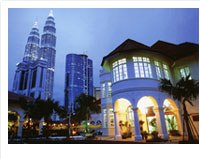
Built along busy Jalan Ampang, this historical landmark used to be a tin tycoon's mansion. It was previously the British war office and the Japanese headquarters during World War II. It was also the venue for the first sitting of Malaysia's parliament and the installation ceremonies of several kings of the country.
This one-stop centre offers a host of facilities for tourists. Its auditorium serves as the venue for cultural performances to give a preface of Malaysia's diverse culture and ethnicity.
For tourists who would like to take a moment to whet their palates, the Saloma Theatre Restaurant offers a multitude of Malaysian delicacies and delights.
Located conveniently next to the Tourism Malaysia Centre, the Saloma Theatre Restaurant provides a gastronomic experience where wonderful aromas and flavours beckon.
|
| [Back To Top] |
| |
KL Railway Station |
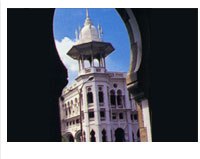
This railway station built in 1910 of Moorish architecture, which features arches, domes and minarets, creates what some has described as a Byzantine Arabian Nights' fantasyland.
The railway constructed to link KL to Klang on the coast, started a network that eventually covered the whole country.
Equally splendid is the Malayan Railway Headquarters overlooking the railway station.
|
| [Back To Top] |
| |
Ramlee Memorial |
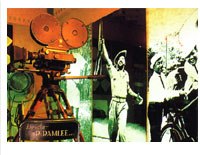
The late Tan Sri P. Ramlee - actor, director, singer and composer extraordinaire was known for his invaluable contributions to the Malaysian music and film industry.
Built in 1926 by P. Ramlee's father and uncle, the memorial is originally P. Ramlee's residence. After several restorations, P. Ramlee's residence was taken over by the National Archives and included as part of the P. Ramlee Memorial project in Kuala Lumpur.
The displays inside and outside the house features the main living areas and also the life history of the late singer, actor, composer and director.
Various artifacts on display include his personal memorabilia related to his life in Penang, and items belonging to his family. These artefacts are displayed within six sections of the house, each showcasing a different phase of the artist's life and work. The memorial is intricately furnished to resemble as close to its original state. There is also an in-house theatre, where visitors can relive P. Ramlee's astounding performances and documentaries.
Opening times:
Daily except Mondays: 9:00am - 6:00pm
|
| [Back To Top] |
| |
Lake Garden |
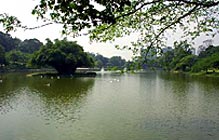
Taman Tasik Perdana, better known as the Lake Gardens, is the oldest and most popular park in Kuala Lumpur. It lies just on the edge of the city and used to be where the British elite built their fine homes in the colonial times.
Today, its landscaped hills and beautiful trails provide an escape for city dwellers out for a jog or some early morning t'ai chi. Its main attraction is the lake surrounded by lush greenery in a 92ha. (227 acres) parkland that provides a refreshing ambience.
Roam through the aviaries at the Bird Park and Butterfly Park. Or take a stroll through the beautiful Deer Park and Orchid Garden, which are all reachable either by foot or by regular shuttle buses. From the gardens, you can also visit other attractions such as the National Monument, the Planetarium and the Islamic Museum.
|
| [Back To Top] |
| |
Bintang Walk |
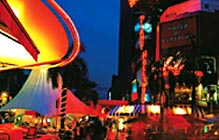
For both shopaholics and coffee-sipping night owls, Bukit Bintang is one of the hippest streets in the city. It's a perfect place for people-watching over a latte between bouts of bargain-hunting.
A wide pedestrian walkway running the length of the street has transformed it into an exciting rendezvous point with open air cafes and restaurants.
The many shopping centres along Bukit Bintang ensure that you will never run out of options.
|
| [Back To Top] |
| |
Petaling Street |
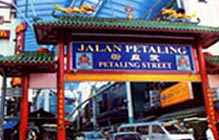
Petaling Street, the centre of Kuala Lumpur's original Chinatown, maintains much of its traditional atmosphere, particularly at night when vendors fan out their merchandise along the street.
While you can shop for anything from gems and incense to toys and t-shirts, the true allure of this night market is in wandering about and enjoying its sights, sounds and energy. Food is plentiful here with many scrumptious varieties to choose from; some of the restaurants here have been in business for generations. Locals flock to Petaling Street primarily for bargain accessories and great Chinese food. So, go on, be brave - head down to Petaling Street with an empty stomach and an adventurous spirit. Even if you don't spend a penny, (which will be hard!), you are guaranteed to have an amazing experience here.
At the end of Petaling Street, you can further explore the Chan See Shu Yuen Temple which dates back to 1906. The interior of this building features open courtyard pavilions, intricate carvings and paintings. On the exterior, the temple depicts elaborate glazed ceramic sculptures which grace the facade and roof ridges.
For more adventurous tourists, further down from Petaling Street is the South Indian Sri Maha Mariamman Temple. This temple is situated at Jalan Tun H.S.Lee which is within walking distance from Chinatown. Built in 1873, the temple is said to be the most ornate and elaborate Hindu temple in the country. The design and decorative features include intricate carvings of Hindu deities, gold embellishments, precious stones and hand-painted motifs. Exquisite Italian and Spanish tiles provide further ornamentation. A silver chariot housed within the premises features prominently in religious processions, transporting the statue of the deity through the city streets.
Outside the Sri Maha Mariamman Temple are stalls selling garlands and strings of sweet smelling jasmine. Additionally, the strong aroma of Chinese traditional herbs and that of freshly brewed coffee waft through the air from across the street.
|
| [Back To Top] |
| |
Jalan Tuanku Abdul Rahman |
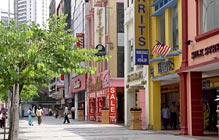
This was the 'grande dame' of KL shopping, in the days before modern shopping complexes took the KL metropolitan city by storm.
This stretch of road is flanked by pre-war buildings whose distinctive facades are preserved and re-adapted to accommodate modern retailing businesses. Here, you can walk through the archways of shops for an immersion into a shopping and cultural experience that goes back several decades to the days before modern shopping centres.
Many established names like GS Gill, P. Lal and PH Henry chose to remain when others moved out. The shops here offer a wide range of fabrics and textiles, imported leather goods, bags and luggage, carpets, sports goods and winter clothing.
Narrow alleys between the shops offer a fantastic range of clothing material at irresistible bargain prices. Other established names offer collections of silver and crystalware. The very modern Sogo Shopping Complex and Maju Junction Mall are also located along this stretch.
Every Saturday between 5.00 pm -10.00 pm, Lorong Tuanku Abdul Rahman is closed to traffic and transformed into a night market where petty traders and hawkers sell an assortment of goods in the open air.
The night market, or literally translated as "Pasar Malam" in the Malay language, offers you an interesting place to walk through and perhaps pick up some casual attire, local products, as well as sample some local delicacies. This experience is a feast for the senses.
|
| [Back To Top] |
|
|
|
Traveling into Kuala Lumpur when compared to Selangor shares no irregularity. Similarly, it is convenient and easily accessible from all major cities and all parts of the country by air, road and rail.
By Air
The Kuala Lumpur International Airport or KLIA is the main entry point into the country and services over 45 international airlines. The city is situated about 55 km. from KLIA.
By Sea
The nation's largest port is Port Klang, with the ultra-modern Westport complementing the sophisticated berthing facilities in the area is about 41 km. away from Kuala Lumpur. Nearby is the Star Cruises terminal, which was built exclusively for the convenience of tourist arriving on cruise ships.
By Rail
An excellent railway network from Thailand in the north and Singapore in the south links Kuala Lumpur.
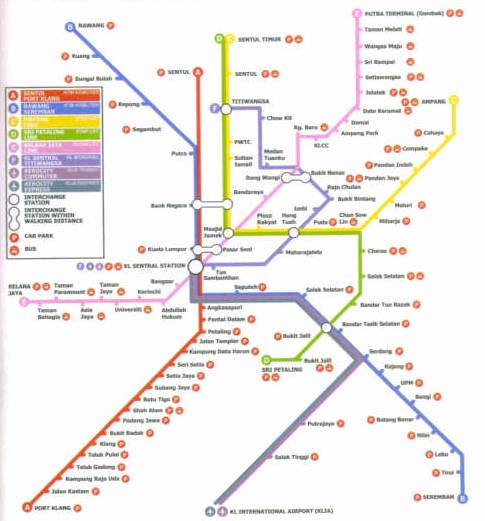
The KLIA Ekspres and KLIA Transit (also known as Express Rail Link or ERL) are the fastest modes of transportation connecting the airport to the KL Sentral Station, the main transportation hub in the city. KLIA Ekpres offers an approximate 28 minutes non-stop ride or so from the airport to KL Sentral. It departs every 15 minutes during peak hours (between 5.00 am - 9.00 am and 4.00 pm - 10.00 pm) and every 20 minutes during off-peak times (between 9.00 am - 4.00 pm and 10.00 pm - 12.00 am). The fare is RM35.00 per way.
The KLIA Transit departs every 30 minutes and stops en route at Bandar Tasik Selatan, Putrajaya/Cyberjaya and Salak Tinggi. The journey to the airport takes approximately 36 minutes and the fare is RM35.00 per way.
KLIA Transit is linked to the KTM Komuter and STAR LRT services at the Bandar Tasik Selatan Station.
By Road
The city's modern transportation hub, come together with the ever improving road systems in tandem with its rapid development provide easy access to any destination into Kuala Lumpur thus offer options for travel to the city center by public transport:-
* KLIA Limousine Taxis
Airport limousine taxis are available at the Arrival Hall on Level 3 of KLIA. These taxis offer pick-up and transfer services using a prepaid coupon system. Travel time to the city takes between 45 minutes to an hour. Fares differ according to the zone and type of taxi (budget or premier). A surcharge will be imposed for transfers between midnight to 6.00 am.
* Airport Coach
The airport coach provides scheduled services to Jalan Duta Bus Terminal and Chan Sow Lin LRT Station in the city. The bus station is situated at the Ground Floor of the KLIA. The airport coach also provides transfer to major hotels in the city and vice versa for departing passengers. However, arrangements must be made 24 hours prior to departure. Travel time to the airport takes about 1 1/2 hours, depending on traffic conditions.
* Car Rental
Alternatively car rental services are available both at the KLIA and at KL Sentral.
|
| [Back To Top] |
|
|
Getting around the city is convenient and affordable. KL Sentral, the city's modern transportation hub, provides a comprehensive network of train, bus and taxi services.
* Buses
Air conditioned buses ply various routes in the main areas of the city. Bus schedules are fairly reliable depending on traffic conditions and the time of the day.
* Trains
An extensive rail transport system links the major parts of the city. The three (3) services available are Putra and STAR Light Rail Transits (LRT), KL Monorail and KTM Komuter. Feeder bus service is available from train stations to designated surrounding areas.
* Taxis
In Kuala Lumpur, taxi fares are based on a metered rate and are available 24 hours a day. The flag-off rate is RM2.00 and RM0.10 is charged for every subsequent 150 meters. Extra charges apply for services after midnight or for services booked by phone.
* Car Rental & Limousine Services
Alternatively car rental and limousine services are also available.
[Back To Top] |
|
|
|
|
|