|
Kuala Kangsar is the royal town of Perak and is located at the mouth of the Kangsar River, where it flows into the Perak River. It is the main town in the administrative district called Kuala Kangsar, accessible via the North-South Expressway.
By the 1890s, the growth of the tin mining towns of Ipoh and Taiping had eclipsed Kuala Kangsar, but it remains to this day one of the most attractive of the Malay royal capitals.
A nearby village called Sayong is located on the opposite bank of the Perak River. It is the production center of the famed labu sayong - a traditional earthenware container. Small villages in the Sayong vicinity include Kepala Bendang and Kampong Bendang Kering.
Sayong is accessible via Kuala Kangsar by two bridges. Sultan Abdul Jalil Bridge, located near the town while Sultan Iskandar Bridge is farther upstream.
[Back To Top]
|
|
Ubudiah Mosque |
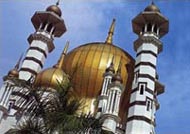
Kuala Kangsar's crowning glory, the Ubudiah Mosque at Bukit Chandan is reputedly among the most beautiful mosques in the country.
Construction began at the turn of the century under the commission of Sultan Idris Murshidul Adzam Shah I, the 28th. Sultan of Perak. Its magnificent golden domes and minarets are hallmarks of classical Islamic architecture.
|
| [Back To Top] |
| |
Royal Museum |
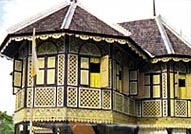
Just next to the Iskandariah Palace in Kuala Kangsar lies the Royal Museum. This architectural masterpiece was built entirely without any plans or nails.
Solid wood was used to build to the palace with the exception of the roof that was built using the waterproof 'kayu berlian' or diamond wood. In true patriotic fashion, the palace was painted in the three official colours of the Perak flag - white, yellow and black that represent the three branches of the royal family. Woven sliced 'bertam' or bamboo with diamond shaped motifs line the inner palace walls. Also particularly unique are the doors at the top of its stairs, which are set horizontally rather than vertically.
|
| [Back To Top]
|
|
|
|
|